





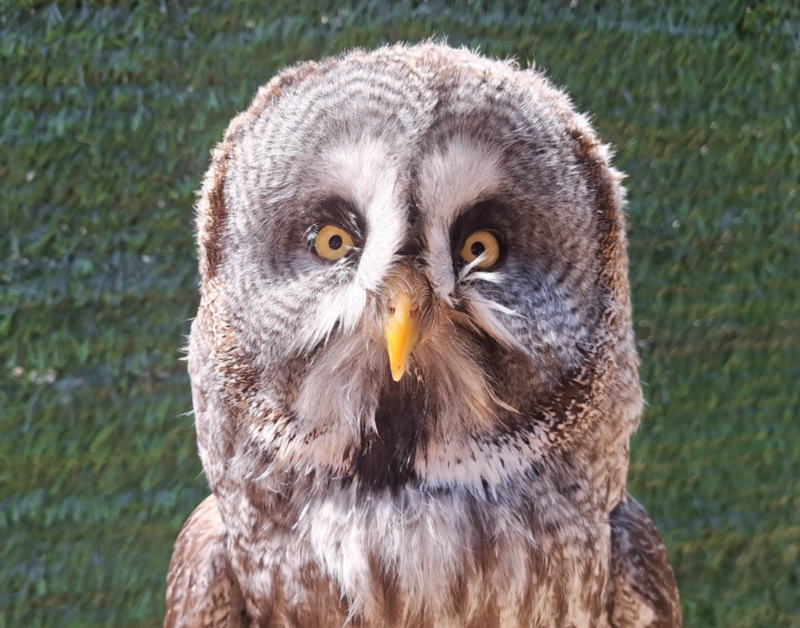
 Terra Natura Benidorm Welcomes One of the World’s Largest and Most Remarkable Nocturnal Birds
Klaus, a Great Grey Owl, joins the park’s educational flight demonstrations, showcasing one of nature’s most extraordinary hearing abilities.
Considered one of the largest nocturnal birds of prey in the world, the species is renowned for possessing one of the most impressive hearing capabilities in the animal kingdom.
The arrival of Klaus strengthens the park’s environmental education and wildlife awareness programs, allowing visitors to discover a rarely seen species and learn about the remarkable adaptations that make it a highly efficient nocturnal predator.
Terra Natura Benidorm currently houses a collection of nine nocturnal birds, including a pair of African owls (Manyu and Moon), a pair of barn owls with different color phases (Chechu and Beyoncé), a pair of Bengal eagle-owls (Atreyu and Chonza), a Verreaux’s eagle-owl named Goliath, a tawny owl called Rico, and now Klaus, the Great Grey Owl.
The addition of Klaus enhances the park’s educational flight demonstrations by expanding the representation of nocturnal birds and offering visitors a deeper understanding of biodiversity and wildlife conservation. Guests can already observe him during daily demonstrations, where he shares the spotlight with other fascinating species.
The Great Grey Owl is notable for being one of the largest owl species on the planet in terms of length and wingspan. Adult birds can reach between 60 and 84 centimeters in length. Despite their imposing appearance, they are relatively lightweight thanks to their dense plumage, which creates the illusion of a much larger body.
Beyond its impressive size, the species is especially famous for its extraordinary hearing. Wildlife specialists consider hearing to be even more important than sight when it comes to locating and capturing prey. Its large circular facial disc acts like a natural satellite dish, collecting and directing sounds with exceptional precision.
Adding to this remarkable adaptation is an unusual anatomical feature: the owl’s ears are positioned at different heights on either side of its head. This asymmetry enables it to determine the exact origin of sounds and create a three-dimensional acoustic map of its surroundings.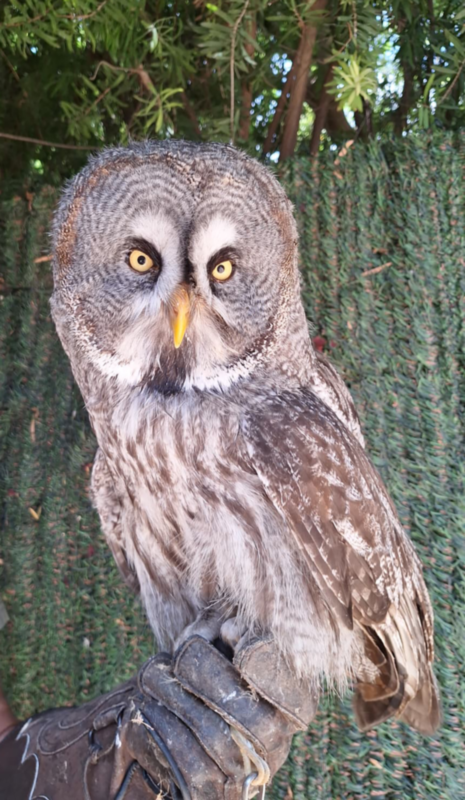
Thanks to these abilities, the Great Grey Owl performs one of the most astonishing hunting strategies found in nature. It can detect small rodents hidden beneath deep snow or dense vegetation without seeing them, relying solely on the sounds they produce.
Klaus’s arrival enriches the educational content of Terra Natura Benidorm’s flight demonstrations, allowing visitors to observe a rare species up close and discover the adaptations that make it one of the most effective nocturnal hunters on Earth.